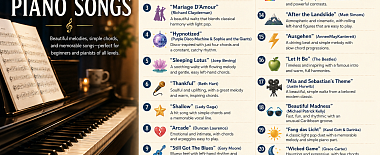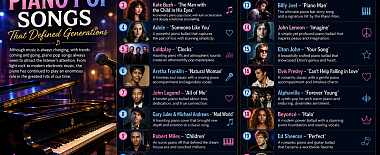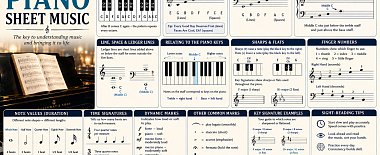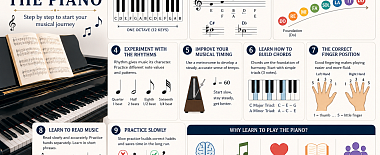

For hundreds of years, the piano has been one of the most important instruments in classical music. Its versatility, wide range, and expressive possibilities make it the perfect vehicle for both intimate solo music and expansive concertos with orchestra. Almost every well-known composer wrote famous music for the piano, and this catalog is truly a feast of wonderful music.
Canon in D - Johann Pachelbel
We begin with a work that has become famous in its many piano arrangements, even though it was originally conceived for a string ensemble. A musical ‘canon’ is a piece based entirely upon a single theme that is repeated throughout. In this case, the 17th-century German composer Pachelbel created a simple bass melody that serves as the backbone for a series of charming, lilting variations. Beginning gently, the rhythmic intensity grows throughout the piece, and the haunting repetitions of its beautiful chords remain in our ears long after the final cadence.
Prelude No.1 in C - Johann Sebastian Bach
Considered one of the fundamental works of Western classical music, this famous piano piece is actually the first in a large compilation of works entitled “The Well-Tempered Clavier” by Bach. The simple arpeggios are slightly altered each time, creating a harmonic journey in which every measure plays its part. Although not well known during the composer's lifetime, this has become one of the most famous piano works in classical music. Furthermore, Gounod composed an additional, superimposed melody: his beloved “Ave Maria”.
Sonata in C Major - Wolfgang Amadeus Mozart
The first movement of this sonata is somehow linked to piano education and is often studied by beginners. However, this song for the piano is so much more. Its opening melody is lighthearted, free, and innocent. The flowing musical lines run cheerfully into one another, and throughout, Mozart adheres to a perfect classical structure. Technically, it does not pose the challenges of other Mozart piano works, but capturing its beautiful spirit is a test for pianists.
Eine Kleine Nachtmusik - Serenade No. 13 - Wolfgang Amadeus Mozart
This is another work best known in its original version for strings, yet the piano arrangements are exhilarating and offer a contrasting sound world. The main melody is arguably the most recognizable musical theme in the classical repertoire. It has been used countless times in radio, television, and cinema, as well as in advertising of every kind, since the dawn of recorded sound. However, its humble beginnings are simple and fun: a piece for string ensemble which Mozart likely composed in a matter of a few days. It holds no hidden meanings and has no overly dramatic qualities. This is purely entertainment music from the Classical period in Vienna.
Moonlight Sonata - Ludwig van Beethoven
Famous piano classics take many different forms. From virtuoso displays to musical portraits, composers have used the piano in almost endless ways. Perhaps none with such originality as Beethoven in the first movement of his ‘Moonlight Sonata’. Composed at the turn of the 19th Century, this shattering work displayed not only Beethoven’s genius in his composition of piano music. It also discarded the frivolities of the Viennese classical era, showing that the piano can take on a darker, more romantic, and even ghostly character. Beethoven indicates this to be played “as a fantasy”, and the resulting mood is mysterious and haunting. Most certainly a piano classic to be played at midnight and by moonlight.
Für Elise - Ludwig van Beethoven
Beethoven’s songs for the piano were not all as somber as his ‘Moonlight Sonata’. This short work, simply dedicated to “Elise,” is one of the most harmonically straightforward pieces from the great German composer. It uses a series of broken chords to create an atmosphere that is lonely yet not tormented. This piano classic is also known as a typical piece for young pianists to learn. The notes can be conquered quite easily, but knowing Beethoven, perhaps an underlying emotion is required to really bring this masterpiece to life.
Prelude in Em - Frédéric Chopin
Chopin’s 24 Preludes offer the listener a very wide range of musical emotions, from lighthearted flourishes to wild virtuoso displays. Nonetheless, it is this seemingly simplest Prelude in E minor that continues to enchant listeners above all. A solitary voice in the right hand of the piano plays a long melody consisting of only a few notes. Alone, this would probably not be so memorable. However, Chopin’s rich, descending left-hand harmonies make the entire experience full of sorrow and anguish. Composed in the late 1830s whilst the composer was living in Paris, this is indeed a piece which demonstrates the emotional power of 19th-century classical piano music.
Liebestraum No. 3 - Franz Liszt
Like Chopin, Franz Liszt was a tremendous pianist whose music sits in the heart of the Romantic era. Liszt’s piano works are often considered extremely complicated, largely because of the huge technical demands he placed on pianists. On the contrary, the music behind many of his virtuoso compositions is relatively easy to understand. This Liebestraum (or “dream of love”) consists of a single, romantic melody that returns several times. Interspersed are some delicate pianistic fireworks, and at times, the statement of the melody is cloaked in some difficult piano writing. It is clear that this famous piano song was originally conceived as exactly that: a song for voice and piano which somehow found its destiny as one of the world’s best-loved classical piano solos.
Brahms' Lullaby - Johannes Brahms
It seems this famous piano song has become well known around the world for its melody and is rightly recognized as a lullaby. It is, in fact, a work for voice and piano, and is still perhaps the most popular bedtime song for children in Germany, who know all of the words! Composed in 1868, it became popular very quickly and remains so today. With simple harmonies and a gently rocking rhythm, Brahms perfectly captured the mood of singing a loved one to sleep.
Swan Lake - Pyotr Tchaikovsky
Possibly the best-loved ballet of all time, Tchaikovsky’s dramatic score has produced piano arrangements ranging from the simple to the virtuoso. The emotional power of the Russian master is especially suited to the piano. The instrument's dynamic range can accommodate long crescendos. Huge, fearsome chords can accompany the music’s sweeping melodies. An orchestral classic becomes a piano classic.
In the Hall of the Mountain King - Edvard Grieg
Few classical pieces have the same dynamic growth as this movement from Grieg's “Peer Gynt” suite. The Norwegian composer was proud of the beautiful and wild landscapes of his country, and of the many old stories that they had to tell. This instantly recognizable melody begins low and almost silently, chanting like goblins from beneath the Earth. As the music develops into a frenetic dance, the piano version becomes increasingly complex and enthralling. Its dramatic conclusion is amazing, whether played by just one or one hundred musicians.
Clair de Lune - Claude Debussy
Quintessential Debussy, and certainly the most famous piece of Impressionistic music for the piano, “Clair de Lune” is a dreamy wonderland of exotic harmony and soulful melodies. It is possible to play or hear this music with other instruments in mind. Indeed, the orchestrated version is full of color and warmth. However, the piano and its own qualities truly shine in this wonderful composition. Debussy’s understanding of how the strings resonate and how piano chords merge is breathtaking. It is indeed a piece for the piano that is heard often, but taking time to really hear the detail of this exquisite writing is worth every moment.
Gymnopédie No. 1 - Erik Satie
Eric Satie was known as an unconventional and experimental composer who worked in France during the late Impressionist era. Nonetheless, his most famous piano work is as well known as that of any of his contemporaries. This first “Gymnopédie” (from a set of three) could be described as the first piece of music to truly focus on mood, and nothing more. It is a short song for the piano lasting around four minutes, in which the simplest of melodies rings through the ears like the sad chiming of bells.
Waltz No. 2 - Dmitri Shostakovich
This Shostakovich waltz has an intriguing history. The original orchestral score was lost during World War II and later found to belong to another suite. Characteristically full of longing, the waltz is easy to play: only a few chords in the left hand and a simple right-hand melody. Its use in Kubrick’s film "Eyes Wide Shut" helped it become a famous 20th-century piano piece.
Clara Schumann – Piano Concerto
The wife of Robert Schumann had an illustrious career as a concert pianist. Perhaps even better known than her husband during his lifetime, she composed hundreds of piano pieces and songs. Typical of the period in Europe, much of her work was intended for a small salon and audience. On the contrary, the Piano Concerto in A minor is a large-scale composition in which the virtuoso soloist battles a large orchestra and is considered one of the first major concertos of the Romantic period.
Frédéric Chopin's "Minute Waltz"
This is a popular, lighthearted piano piece that is surrounded by some misunderstanding. Its descriptive title is not a reference to a ‘minute’ of time, and Chopin certainly did not intend for it to be played within sixty seconds (although many pianists have attempted this). Rather, it comes from a French term meaning ‘miniature’ in size, and the waltz is generally played in around two minutes. It has all the characteristics of a musical joke (or ‘scherzo’) and dates from the last few years of Chopin’s life. Its elegance and fun have made it one of the shortest pieces of famous piano music.
Rebecca Clarke – Piano Trio
Rebecca Clarke’s music bridges the Romantic period and the more experimental, dissonant styles of the early 20th Century. Her work was heavily influenced by the French Impressionists and was even mistaken for Ravel's during her lifetime. Born in England, she made her home in New York and was best known as an outstanding viola player. Many of her compositions reflect a deep understanding of chamber music, and the turbulent, sorrowful Piano Trio (dating from 1921) is a fine example of post-war sentiments expressed through music. Like so many female composers, her gender denied her the rightful fame she deserved during her lifetime. Thankfully, her music is becoming ever more popular in the 21st Century.
Robert Schumann – Scenes from Childhood
Many well-known classical piano works consist of famous melodies, dramatic developments, or beautiful textures. Schumann’s “Kinderszenen” earns its reputation through its charm and the images it creates. It is a volume of 13 short piano pieces that conjure all of the innocence, dreaming, and naivety of childhood. Often misinterpreted as pieces for children to play on the piano, many of the movements pose great technical and musical challenges. Some are designed to depict actual childhood scenes, whilst others are simply youthful moods or ideas. The most famous movement is undoubtedly no.7 - “Träumerei” (“Dreaming”), where this childhood innocence is captured beautifully on the piano.
J.S. Bach – The Well-Tempered Clavier
One of the masterpieces of classical piano music, this expansive catalog is a musical bible for many pianists. It actually consists of two individual volumes, in each of which Bach composed both a Prelude and a Fugue in all of the major and minor keys. Perhaps the most outstanding aspect of these landmark compositions is not the complex, contrapuntal writing in the fugues. Nor is it the innovative, daring use of new harmonies and musical developments. Even greater than these is Bach’s ability to offer 48 completely genuine and uniquely characteristic pieces. This is far more than a collection of works for learning about harmony and improving piano technique. This is a compendium of human emotions, portrayed through brilliant keyboard music.
Wolfgang Amadeus Mozart's "Turkish March"
It is interesting that Mozart’s most famous piece for solo piano is not one of the elegant, perfectly-structured gems for which he was so well known. Instead, it is a simple dance “in Turkish style”. The middle of the 18th Century in Vienna is regarded as the height of the Classical era, yet the Viennese also had a taste for the unusual and the exotic. At the time, cultural flavors from ‘distant’ lands such as Turkey were considered delicacies, and Mozart’s “Turkish March” is just that. It takes the form of a Rondo, in which the main theme repeatedly returns, with contrasting sections placed between.
Gershwin – Rhapsody in Blue
A virtuoso concerto for solo piano and orchestra, “Rhapsody in Blue” is by far George Gershwin’s most famous work. It brilliantly combines elements of the traditional classical style with the new musical ideas of the blues and jazz worlds, which were becoming increasingly popular in the early 20th Century. From its evocative opening to its grand finale, the Rhapsody is full of rich melodies, experimental harmonies, and pure fun. It even includes a musical depiction of a train - probably of the New York subway - gaining speed and racing down its track.
Liszt – Piano Sonata in B minor
Many short works by Hungarian-born composer Franz Liszt have become popular over the past 150 years. His greatest testament, however, is surely his large-scale Sonata in B minor. Following the Classical era, where sonatas were often short, simple pieces, Liszt changed the playing field altogether with his colossal, 30-minute masterpiece. More like a symphony for the piano than a sonata, the music is not separated into individual movements. Instead, it is through-composed, adding to the already fiendish technical challenges which Liszt presents. It uses a form of ‘thematic transformation’, in which a simple melody is altered very slightly yet regularly, eventually creating something which is related yet new and unique. The Sonata, completed in 1853, is considered to be an essential part of a concert pianist’s repertoire.
Rachmaninov – Piano Concerto No.2 in C minor
Following several years of depression, Russian composer Sergei Rachmaninov created some of his most famous and beloved works around the turn of the 20th Century. This soaring concerto combines a personal, romantic style with a full Russian flavor. Long, expansive melodies and dazzling piano virtuosity make this a wonderful concert hall experience. Its deeply sentimental second movement is perhaps its highlight and has been used many times in film. Fans of Hollywood will know this most memorably from its use in the 1945 movie “Brief Encounter”. Rachmaninov’s piano music remains hugely popular today, with this second Piano Concerto still certainly his most famous work.