
The piano is perhaps the world’s best-loved instrument, and has captivated players and listeners for around 300 years. It is extremely versatile and is used in music from the Baroque period to the present day. Learning to play the piano is a wonderful adventure for many people, and whatever your musical experience or tastes, there is a world of piano music waiting to be discovered.
Methods for learning to play the piano are as varied as those for learning languages. Teachers are passionate about many different approaches to the instrument, and there are endless distinctive techniques to be used, depending on the style of music we want to play. The good news is that there are some fundamentals that apply to virtually all teaching and learning systems. These are the educational basics, which cover areas such as getting to know the instrument (both physically and musically), some study of simple music theory (such as musical notation and the various symbols used), rhythmic understanding, and (arguably most importantly) learning how to consistently improve our playing on our own.
Learn the Keys
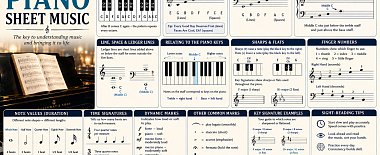
There simply cannot be a best way to learn the piano, as we all develop the necessary skills in individual ways. However, we can perhaps begin by becoming familiar with the piano's key structure. A violinist or cellist changes the pitch of the sound by adjusting the length of the vibrating string. On the piano, our pitches are fixed to each key, and the piano is divided into units called octaves, each consisting of 12 keys (black and white). An octave is a unit of measurement in the Western musical system that describes the difference between one pitch and a second, related pitch (either higher or lower). Scientifically speaking, these pitches are related through frequencies and mathematics. Wherever you begin on the piano keyboard, you can calculate one octave by simply ascending or descending by 12 keys. At this point, you begin a new octave, and the pattern of black and white keys begins all over again.
A teacher, a visual aid, or simply a picture on the internet will show you how to find the name of a particular key. Once you know one, you can work out the rest of the keyboard by yourself. In each octave, there are seven white keys, lettered alphabetically from A to G. There are also five black notes that fit within these seven white keys. It’s important to remember that, wherever we are on the piano keyboard, the system of 12-note octaves remains the same. Therefore, on a modern piano with 88 keys, we have a little more than seven octaves available.
Learn the Musical Symbols and Notes
Standard musical notation is set out on diagrams known as staves. A stave (or staff in American English) is a set of five horizontal lines spaced equally apart. We place a variety of symbols upon these staves to indicate which pitches (or, on the piano, which keys) are to be played. Each of the horizontal lines and the spaces between them represents one of the lettered notes from A to G. Therefore, playing a symbol on a line followed by a symbol in the space above it translates to one of the white notes on the piano followed by the white note directly above it. A tutor or some illustrated assistance will quickly help to learn which lines and spaces correspond to which piano keys. Further symbols, known as sharps and flats, are used to change the pitch of a note to the black key directly above or below. Sharps raise the pitch by a half-step, also called a semitone, which is the smallest interval between two adjacent keys on the piano. For example, when we add the sharp symbol (#) to G, it raises the pitch by one semitone to G-sharp. The G is a white key on the piano, whilst G-sharp is the black key directly above (to the right) of it. Similarly, the flat symbol (♭) lowers a note to its flattened version, and so E (a white note) becomes E-flat, the black note one key lower (to the left).
This musical system is unique and, when we begin to learn the piano, can seem complicated and even daunting. However, some patience, a good amount of enthusiasm, and preferably a good teacher or excellent learning materials will guide you through this step-by-step.
Play Do-Re-Me
Another system of musical learning, often used with children, is the solfège (also known as solfa or sol-fa) method. This is not a written form of notation but rather an aural method of musical communication, widely recognized by the terms “Do - Re - Mi”. In this system, all pitches are related to a foundational note (the “Do”). The difference is important to understand. In our accepted Western system of pitch and notation, the notes of each octave have (approximately) predetermined frequencies. That is to say, a middle C on one piano should sound the same pitch as on another instrument: approximately 262 Hz. In the solfège system, this is irrelevant. All music and its harmonic developments have a “Do” (at any pitch) as its bedrock, and the rest of the tones are simply in relation to this foundation. Solfège can certainly be an enjoyable and advantageous subject of study. It can be particularly useful for improving aural understanding of intervals and the relationships between notes within a harmonic infrastructure. However, its limitations make it no match for the far more complex notational system that is commonplace.
Experiment with the Rhythms
A vital element of any music-making is rhythm, and when we begin learning to play the piano, this should be treated with the same importance as simply playing the correct notes. Rhythm, alongside melodies, chords, and musical texture, is a building block that gives a piece of music its character and individuality. Up until the Twentieth Century, the rhythms found within Western classical music were (on the whole) created through symmetry. A piece would have a basic tempo, in which a single beat (usually known as a quarter note) would last for an agreed length of time. The duration of almost all other notes in the music would be related to this: they would last just as long, half as long, twice as long, 1.5 times as long, etc. Regardless of how complex the combinations of note durations become, this relationship to a steady pulse (or beat) creates rhythm. Of course, this is just the tip of the iceberg. The full story of rhythm is much more complicated, with elaborate beat patterns originating in different parts of the world and with jazz musicians playing free rhythms over a steady backing beat. When learning the piano, it is important to observe rhythmic patterns as accurately as possible. However, a certain amount of experimentation at the keyboard will help understand how different rhythms feel and how the hands adapt to playing them.
Improve your musical timing.
Like all musical skills, rhythm will develop with time and practice. One of the best ways to improve this aspect of piano learning is with a metronome. Offering a perfectly consistent tempo, this device can help us improve our musical timing. Practicing by following its beat precisely will hugely benefit the “brain to finger” relationship, which is so essential in piano playing.
Learn how to build chords.
Another good area where it is beneficial to experiment at the piano is with chords. However simple or sophisticated they might be, they form the backbone of harmony and, therefore, how music sounds. Some basic learning material will instruct on how to form simple major triads using a bass note and two higher notes, which are respectively four and seven keys (or half-steps) above that bass foundation. Learning to form these from different bass notes will begin to develop some keyboard-related harmonic understanding, and the same can be done with minor triads. By experimentally adding an extra note to these triads, we will also start to learn about the many different colors that these intricate chords can show.
The correct finger position
The physicality of playing the piano must not be forgotten, including paying close attention to fingering and hand positions. Whilst it’s usually possible for people to fumble through, finding ways to successfully play their music through trial and error, a far more valuable approach is to study the advice on finger positions offered by either the printed score, a teacher, or a combination of the two. There are no strict rules about which fingers should play which keys. Indeed, there have been extremely successful pianists who adopted completely unorthodox techniques. On the whole, however, some diligence here will truly benefit the learning pianist. Good fingering technique is designed to facilitate the hand's passage with the greatest ease. It limits unnecessary or awkward changes in hand position and assists with fast, fluid playing. It will later become a solid skill that will make all piano playing easier.
Learn to read music
Those new to learning the piano often complain that they can play pieces by ear quite quickly, yet reading printed music is a much greater challenge. The key here is perseverance and good practice technique. When a child learns to read, a good teacher will encourage slow, accurate reading. Of course, this is far more beneficial than a hurried attempt full of mistakes. Learning to read music at the piano is no different. It is extremely important to take the time to get things right from the beginning, as this will save so much time (and frustration) later on. If your music is written for both hands, then practice them separately to begin with. Read the music slowly and learn in short phrases, first discovering how to play the notes accurately, and then in exactly the rhythm printed.
Practice slowly
This basic concept of slow practice is possibly the most important (yet often most difficult) discipline for piano students to adopt. Of course, we all want to learn to play well as quickly as possible. Nevertheless, so much practice time is wasted around the world every day, due entirely to impatience. A steady, meticulous, and self-critical approach actually helps our brains learn much faster than a flurry of mistakes. Whatever style of music and whatever pieces you want to play, you’re encouraged to give this a try. The results might just amaze you.