
Learning how to read piano sheet music is one of the most important parts of playing the piano. It is a skill that can make playing music more fun and lets us easily learn many songs.
Why should you learn how to read sheet music?
There are indeed good pianists around the world, including even a few famous names, who are fine musicians yet do not read sheet music. However, these are very rare, and it is strongly advised that all piano students continually develop their skills in this area. The most obvious and important reason for this? Sheet music is the medium that connects the composer or songwriter to the pianist (or other musician). It is the means of storing music before it is brought to life and converted from dots on a page into wonderful sound. It is, at least in the Western musical system, an accurate and concise way of quickly showing musicians the main ingredients of the music they are going to play. The pitches of the notes themselves and their durations are obviously the key pieces of information available. However, sheet music also provides detailed information on the dynamics (or volumes) of the notes, along with how they should be played expressively. Some information about the tempo (and how it might change throughout the piece) is usually available, as well as general words describing the mood and intentions of the piece.
Music sheets are essential for musicians of all styles and levels of ability. Beginners often find learning the sheet music system arduous and painstaking. It is fairly normal for them to simply want to play the piano, and this impatience can lead to questioning why reading music is important. However, they should be reminded that even the most basic skills in musical reading will allow them to discover and learn to play far more new music (at a much faster pace) than learning by ear. Studying a wider range of music in the first months of learning will help them master their basic technique. General ‘brain-to-finger’ coordination is improved by reading sheet music, and the whole learning process will soon become more effective and enjoyable.
Piano sheet music is an invaluable tool for teachers, helping them quickly expose their students to large amounts of music. Furthermore, the world of professional music would hardly exist without this common system of musical language. Whilst a restaurant or hotel pianist might have a large repertoire learned from memory, there’s no question that his or her piano bar notes gave them fast access to such a wide range of songs. The world’s top session musicians are relied on to read music at the highest level, enabling players (who may not even know each other) to come together and record multiple tracks in a single session. In the classical field, it would be almost impossible for professional orchestras and opera companies to offer the large number of productions we see today without musical scores, which serve as the guidebooks for rehearsals. In fact, almost all classical repertoire would be completely unknown without sheet music. Without recording devices or electronic storage, the works of composers before the turn of the 20th Century are preserved today only in sheet music.
Musical Alphabet
The first steps in learning to read musical notation can be daunting. It can appear unnecessarily complicated until the general framework is absorbed. Perhaps most important to remember is that this apparently huge system (which covers all of the keys on the piano) is actually broken up into concise, digestible segments. The musical alphabet runs only from “A” to “G”, which are white keys on the piano keyboard. Further notes exist in between these letters, whereby the notes are adapted to be slightly lower or higher. With these extra keys included, we use only a system of twelve named notes. After this, the system simply begins again. By beginning on any note, we can ascend or descend by twelve adjacent notes and will reach the same note either one octave higher or lower.
Treble Staff
Our Western system of musical notation uses ‘staves’. A singular ‘staff’ is the diagram of five equally spaced horizontal lines, and symbols representing musical notes are placed upon either the lines themselves or in the spaces between these lines. Moving from the bottom upwards, each line and space represents a lettered key from “A” to “G”. Therefore, the five lines (plus the four spaces between these lines) represent a total of nine letters (or white keys on the piano keyboard). For beginners learning to read piano sheet music, it’s important to understand that these staves show only a particular portion of the keyboard at any given time. You might think of the entire keyboard as one enormous staff with many, many lines and spaces. However, this would be incredibly messy and illegible.
The system of five-line staves exists to show clearly which part of the keyboard the music is happening within, and there are specific symbols (named ‘clefs’) which indicate this. The first clef to be learned is the ‘treble clef’. Its symbol is probably recognizable to beginners, and it defines the lines of the staff as “E”, “G”, “B”, “D”, and “F” (from bottom to top). With these particular notes assigned to the lines of the stave, it follows that the four spaces in between the lines indicate the notes in between: therefore “F”, “A'', “C”, and “E” (again, moving from bottom to top). Teachers use a variety of methods to help beginners remember these definitions. The most common little phrase seems to be “Every Good Boy Deserves Fruit”, with the first letter of each word making the EGBDF definitions for the lines from bottom to top. The spaces are often simply remembered as the spelling of the word “FACE”. For advanced piano playing, even the clef symbols themselves can become altered. However, it should be noted that this basic treble clef symbol defines exact keys on the piano. These are the keys directly above ‘Middle C’ (which can be found using a visual aid or a teacher).
Bass Staff
The second important clef when learning how to read musical notes is the ‘bass clef’. This takes care of the notes found directly below ‘Middle C'. When the bass clef symbol is seen on the staff, then its five ascending lines denote “G”, “B”, “D”, “F”, and “A”. The ascending spaces are therefore “A”, “C”, E, and “G”.
Put the Treble & Bass Clef Staves Together
Of course, it’s possible for any staff to indicate notes that lie outside of its five lines. This is done by temporarily adding another short line either above or below the staff. These are known as ‘ledger lines’. The notes simply follow the alphabet in either direction, using the standard line-space-line system. Looking at the treble clef (where the bottom line indicates the note “E”), this means that the space directly below this bottom line is a “D”. Although we are now outside of the standard staff, we can descend further by adding a short ledger line below the staff and placing a note upon it. This would therefore be a “C” and, incidentally, this is ‘Middle C’ itself.
How Do the Lines & Spaces on the Staff Relate to the Piano Keys?
By way of example, in the bass clef, we can ascend from its top line (which is an “A”) by placing a note in the space directly above this line. This is therefore a “B”. Ascending further, we can insert a small ledger line to indicate the next key upwards, which would be a “C” and, again, this is ‘Middle C’. We could continue to ascend further by placing more and more ledger lines above the staff, indicating higher and higher notes, but this would soon become difficult to read. Instead, we can simply move our notes to a staff using the treble clef, and we are back to the more legible five-line system. So, it can be seen that Middle C appears just above the top of the bass clef staff, and just below the bottom of the treble clef staff. It can be written in either way, and is exactly the same key when played on the piano. For this reason, straightforward piano music generally consists of both staves printed one above the other, with some space in between for clarity. The treble clef staff is normally used for the higher, right-hand notes of the music. The bass clef staff indicates the lower notes, played by the left hand. This two-staff system covers enough notes of the piano keyboard to make an enormous amount of music playable. There are enough keys available in the upper parts of the treble clef staff for high melodic material. The lower part of the bass clef staff allows for deeper notes, offering a solid harmonic basis, and there is still plenty of room in between for other voices and chords. This is two-hand piano sheet music in its most familiar presentation, and is systematic and easy to read.
Sharps & Flats
Once we have determined which white keys (“A” - “G”) are to be played in our two-staff piano sheet music, we can turn our attention to the black notes that are found in between. They are referred to in different ways: either as a note which is ‘raised’ from the note directly to its left on the keyboard (in which case it is a ‘sharp’), or ‘lowered’ from the note directly to its right (in which case it is a ‘flat’). Therefore, the black note between a “C” and a “D” can either be referred to as a “C-sharp” or “D-flat”. These alternative names for the same key will become easier to understand after some further study of music theory. For beginners learning to read sheet music, it is sufficient to grasp that this C-sharp or D-flat is the same, physical black key on the piano. You’ll notice that no black key exists between “E” and “F”, as well as between “B” and “C”. Nevertheless, the system of referral stays the same: “E” is one key directly below “F”, and is therefore (very occasionally) referred to as “F-flat”. Similarly, “F” can be referred to as “E-sharp”. “B” can sometimes be called “C-flat”, and “C” is occasionally known as “B-sharp”. This can seem complicated in written English, but a small amount of time studying this at the piano keyboard should make it fairly comprehensible.
The symbols for these in our sheet music are fairly straightforward. A note appearing as a “G” in our staff is altered to a G-sharp when we see the sharp (#) symbol directly before it. We then play the G-sharp black key to the right of the G instead. Equally, the flat (♭) symbol lowers the printed note. In more complex music, a mixture of sharps and flats is found in our printed scores, which can make it tricky to read. However, simpler music will normally use either just flats or just sharps, or, of course, sometimes none at all.
Due to the system of major and minor keys that has developed over several hundred years, it is very often the case that a piece of music or song might almost always require the F to be an F-sharp. Equally, it is common that music might need all the B’s to become flattened into B-flats. In these cases, instead of always adding the sharp or flat symbols to such notes (and thereby creating a messy score which is littered with these), we can use a ‘key signature’. This is a method of indicating that, for example, all of the F’s which we see printed must actually be played as F-sharps. In this example, if we’re using the treble clef, the sharp (#) symbol will appear alone (without a note) at the beginning of the staff on the top line, which is of course F. Equally, the flat (♭) symbol appearing on the third line of the staff (the B) before the musical notes will indicate that all B’s are to be played as B-flat.
Finger Numbers for Piano Players
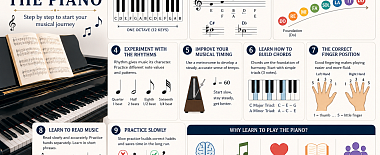
The numbers commonly placed above or below the notes themselves are called fingerings. These essentially advise the pianist to play certain notes with specific fingers, aiming to create the easiest, most comfortable hand position. Good fingering is essential to piano-playing development, and whilst good editions of sheet music will have sensible fingering suggestions (usually from professional pianists), it’s also valuable to learn how to create good fingerings for ourselves. Furthermore, a pattern that works well for one pianist might be uncomfortable for another. This is an area that deserves some experimentation. The standard system in piano sheet music is that 1 refers to the thumb, 2 to the first (index) finger, and so on through 5. This is the same in both hands, so it’s worth noting that playing 1 through to 5 in the left hand would be a descending musical passage, whilst in the right hand it would ascend.
Note Values
Whilst the placing of the note symbols upon the staff informs us which keys to play, it is the type of symbols themselves that determines the duration of the notes. A great deal of both classical and popular music is perceived in groups of four beats (or pulses). This has no relation to the music’s tempo, which can of course become faster or slower. When a strong beat followed by three weaker beats makes up a standard grouping, the music is said to be ‘in four’ or sometimes ‘in common time’. In this case, each singular beat is referred to as a ‘quarter note’ (or sometimes ‘crotchet’), and the relevant (????) symbol is used. A note lasting twice this length is known as a ‘half note’ (sometimes ‘minim’) and is recognized by its ‘unfilled’ (????) symbol. These would be the first two note values to study when learning to read sheet music, before moving on to more complex values.
Time Signatures
Our sheet music is normally divided into measures, which regulate the feel of the music and make for easy reading, much as written language without punctuation can be very difficult to read. In general, the number of beats per measure is shown at the beginning of the music using a ‘time signature’. The most common ‘in four’ music can be indicated with a “4/4” symbol, whilst music which has three beats to a measure (such as a waltz) would be indicated by a “3/4" time signature. These, respectively, simply mean four ‘quarter notes’ per measure, or three ‘quarter notes’ per measure.
Dynamic Marks
The feeling of piano music is strongly affected by how we strike the keys and the dynamics at which we play. In this respect, it is normal for composers to write their wishes into the scores. Contemporary musicians often simply use their own language to make such dynamic indications, but the traditional method stems from the Italian language and is very straightforward. When the music is to be played loudly, the Italian term forte (meaning ‘strong’, and often abbreviated simply to f) is used. Equally, the indication for quiet playing is 'p', for piano. Again, these would be the most basic and commonly used dynamic markings in piano sheet music. However, they form the emotional backbone of how our music is communicated to listeners.
How to Maintain & Improve Your Sight-Reading Abilities
As with a good recipe, all ingredients must be carefully selected to develop solid skills in reading piano sheet music. Of course, the accuracy of the notes themselves is hugely important, yet a performance devoid of feeling and flair can be rather boring to hear. In the early stages of the process, it’s expected that pianists will focus on the notes themselves, yet it is very important to read and absorb the information surrounding the musical symbols. Great music readers can take in huge amounts of this information at incredibly fast speeds, and many build great careers on this alone. The key to this, of course, is practise, and in particular slow and accurate practise. Hearing pianists attempt to read sheet music too quickly is not only a little unpleasant to the ear, but it also does them more harm than good. The brain (and its subsequent transmission of signals to the arms and hands) will not benefit very much from seven or eight rushed, failed attempts at reading a musical passage. Even if the subsequent endeavor is accurate, they have spent far more time getting it wrong than getting it right. A much more beneficial approach is to start at an extremely slow tempo. This allows the processes to occur accurately and for the brain to actually learn them. Giving plenty of time to carefully read exactly which notes come next (and to contemplate the movements of wrists and fingers needed to achieve them) will build strong sheet music-reading skills. Speed will come later, and whilst this approach may require more patience than simply ‘giving it a try’, it is a far better long-term practise.
Sheets of music are rather unimportant if they are not given life by musicians. We are lucky to have such an enormous amount available to us. Let us take the time to learn how to read and play them well. It is a special skill that is incredibly rewarding.